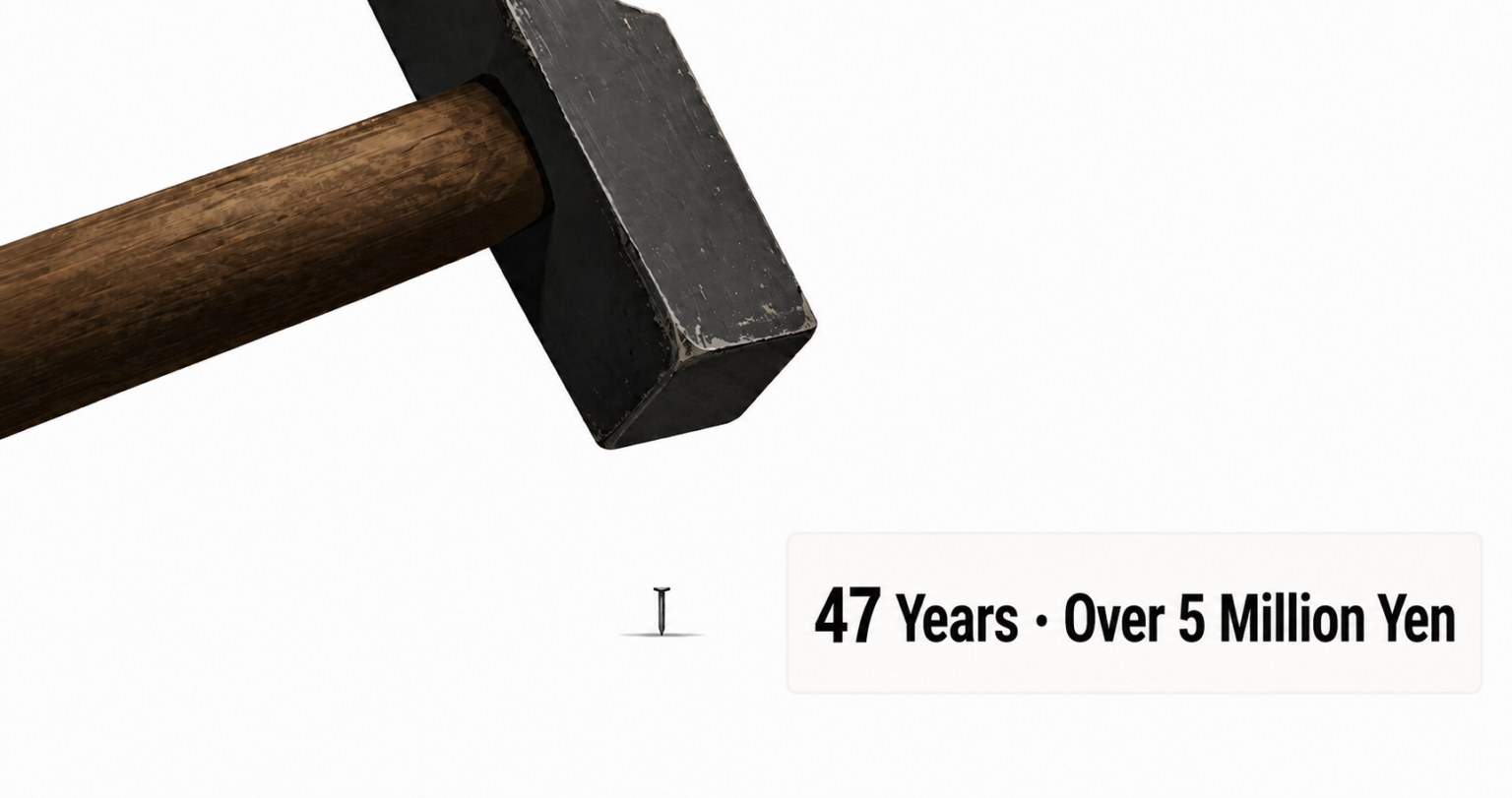
I had life insurance from the age of 20.
When I noticed, 47 years had passed.
I paid at least 10,000 yen a month.
By my count, it was over 5,000,000 yen at the very least.
It may have been the biggest expense of my life that I never noticed.
In March 2024, I quit all of it.
- It Started with My Aunt
- For 47 Years, I Did Not Notice
- 800,000 Yen in the Last 74 Months: MetLife
- Insurance Gives You a False Feeling of Safety
- I Removed the Riders Step by Step, and Finally Cancelled Everything
- Pension Life and Public Payments Taken Out
- Is the Surrender Value Taxed?
- If Only I Had Noticed Sooner
- The Money University Does Not Say No to All Life Insurance
- My Conclusion: Reviewing Is Different for Each Person
It Started with My Aunt
When I was about 20, one of my aunts worked as an insurance agent.
I signed up to keep good relations. I did not think deeply about it.
Back then, I knew nothing about insurance.
I thought it was just something you buy when you become an adult.
I also wanted to help my aunt save face.
After that, 47 years passed.
I kept paying 10,000 yen a month.
For 47 Years, I Did Not Notice
My family changed.
My income changed.
My children became independent.
I paid off my home loan.
But the insurance stayed the same as when I was in my 20s.
I could not even explain to myself why I had this insurance.
The monthly payment was like air.
I did not even think about it.
This is what they call inertia.
800,000 Yen in the Last 74 Months: MetLife
The only policy I still have exact numbers for is the most recent one, a whole life medical policy with MetLife.
My monthly premium: 10,876 yen.
The main contract was 2,420 yen, plus five riders (longer hospital stay for seven major illnesses, advanced medical treatment, outpatient care, death benefit, and surgery).
My wife also paid 9,726 yen a month on her own policy.
I paid for 74 months (6 years and 2 months). For me alone, that was about 800,000 yen.
“Do I really need all five riders?”
I first thought about this seriously when I was 64.
It was too late.
Insurance Gives You a False Feeling of Safety
It is strange. Once you have insurance, somehow you start to feel that you will not get sick, or that things will work out if something happens.
Of course that cannot be true, and I knew it was a strange feeling.
Having insurance does not cure an illness. Medical care is what treats an illness. Insurance only covers the money problem.
A machine you pay money into, to make your worry go away.
Maybe that was the true nature of insurance.
As I looked into it, I also learned that the public health insurance system keeps many medical costs down.
With the high-cost medical expense system, there is a limit on what you pay yourself each month.
If you have some savings, you can handle the treatment costs you can expect.
I chose to decide based on facts, not on worry.
I Removed the Riders Step by Step, and Finally Cancelled Everything
I did not do it all at once.
First, I removed the riders I thought I did not need.
The longer hospital stay for seven illnesses, advanced medical treatment, lifetime outpatient care, lifetime death benefit. One by one, I decided “I do not need this.”
The death benefit rider also had a surrender value (over 250,000 yen).
Some of the money I had paid came back.
And in the end, I cancelled the main contract too.
In March 2024, the life insurance I had kept for 47 years went to zero.
Pension Life and Public Payments Taken Out
There was one more reason why I quit everything in March 2024.
It was just when I was starting to live on my pension.
National health insurance, long-term care insurance, and taxes are taken out of the pension.
My income goes down, but the public payments taken out are quite large.
I no longer had room to keep paying for private insurance too.
This was also one of the reasons I quit my life insurance.
Is the Surrender Value Taxed?
I checked whether the over 250,000 yen I got back would be taxed.
According to the National Tax Agency, a surrender value received as a lump sum is “occasional income.”
You take the amount you received, subtract the premiums you paid, and then subtract a special deduction of 500,000 yen.
Half of what remains is taxed together with your other income.
In my case, what I paid was far larger.
The result was below zero, so nothing remained.
So I did not need to worry about tax.
Note that when the person who paid the premiums and the person who receives the money are different, it becomes a gift tax matter, not income tax (National Tax Agency).
If Only I Had Noticed Sooner
I will be honest.
I regret that I did not notice sooner.
All I can do is regret how little I knew.
From age 20 into my 60s, over 10,000 yen a month.
I paid more than 5,000,000 yen, and nothing happened.
If someone had told me when I was young, “Insurance is a matter of probability”…
If I had known, “Public insurance covers a lot”…
My fixed costs over my life would have been completely different.
But regret will not change anything.
Now that I have noticed, this is the earliest I can start.
The Money University Does Not Say No to All Life Insurance
I want to write down something important.
The Money University (a popular money book in Japan) does not say “you do not need any life insurance.”
It says that when something is unlikely but would ruin your family if it happened, you prepare with insurance.
To be specific, if you have small children and the person who supports the household falls ill or dies, the family cannot get by.
For such people, the book says, term life insurance with no savings part, like family income benefit insurance, is necessary.
In my case, I am in my 60s and my children are independent.
I do not support my family financially.
So it was not needed. That is all.
If you are young and have small children, it is a different story.
Please do not mix that up.
My Conclusion: Reviewing Is Different for Each Person
I quit everything.
But I do not say this is the right answer.
For people who worry a lot, insurance has meaning. For households with room in the budget, it gives peace of mind.
Still, I think it is worth looking at what is inside your policy at least once.
If you cannot explain in your own words why you have it, it may be inertia.
I did not notice for 47 years.
How many years have you left your own insurance alone?
コメント