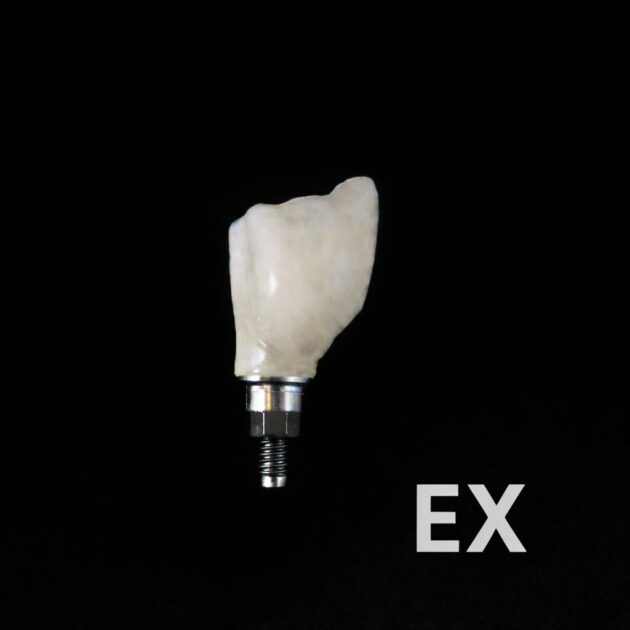
When people hear “root canal treatment,” I think many of them imagine it will hurt. At first, I thought so too. But when I actually had it, it did not hurt at all.
The root of a tooth was rotten. I had been worried only about my implant, but there was a problem hiding in another tooth too. In that treatment, I came across “electric disinfection.”
My Mouth Had 3 Bad Spots
At the end of last year, a filling came out, and that is how I started going to my current dentist.
At the first visit, the dentist checked my whole mouth. As a result, I was told there were 3 bad spots.
1. Left back tooth. This is the tooth that was replaced with an implant. I wrote about it in my earlier posts, Part 1 to Part 5.
2. A bridge on my right back teeth. A 3-unit bridge put in by my former dentist. It seems it was made with no thought at all about how the force acts on it (the moment).
3. A bridge on my left canine tooth. It had a strange filling.
This time I am writing about number 3.
The Root of the Tooth Was Rotten
For number 3, the canine tooth, the first step was to drill out the strange filling. They also took a CT scan and checked the area carefully.
What they found there was that “the root of the tooth is rotten.”
Honestly, it was a shock. My mind was on the implant, but there was a problem hiding in another tooth too. At the first visit I had been told there were 3 spots, so I was ready for it. But when someone actually says “it is rotten,” it still feels heavy.
A Treatment Called “Electric Disinfection”
To fix it, the dentist gave me a treatment called “electric disinfection.”
I was given a silver tube to hold in my left hand. It was like the grip of a bicycle. They placed something against my tooth and ran an electric current. I guess the current was going through my body. It felt like they were grounding me (this is my guess).
It was over in about 5 minutes. There was no pain at all. It seems they will do this disinfection again at my next visit too.
Later I was curious and looked it up. Its formal name is “iodine iontophoresis.” They put an iodine-based medicine inside the root canal and run a weak electric current. This pushes the medicine deep into the root, where it normally does not reach well, and kills the germs.
It seems the silver tube I held in my left hand is the “counter electrode (the electrode on the ground side).” It makes a loop of current through the body. A nurse (I think it was a nurse) explained it briefly.
When I looked it up, I found it has been used in Japanese dentistry since the 1950s. But it seems many dental clinics do not use it. Maybe the dentists who still use this treatment keep it as one of the skills of a veteran.
A Thin Thread Like Gauze: The Paper Point
Before and after the disinfection, there was a moment when they put something like a thread, like a small twisted piece of gauze, into the root. It was the same check I wrote about in Part 2.
I looked this up later too. It is a tool called a “paper point.” They use it to see if pus or fluid is still left inside the root canal. If the tip comes out dirty, “there is still pus.” If it comes out white and dry, “it is clean.”
It is a simple but sure way to judge the healing by looking at it.
If This Does Not Work
The dentist told me gently.
If this disinfection does not work, they may need to pull the tooth and treat the part with pus directly.
Even during the period of waiting for the base of the implant to join with the bone, my visits to the dentist do not stop. I also wrote this in Part 5. During the waiting period, I am fixing the other bad spots at the same time.
I am in my 60s. The bill for not getting properly checked when I was young is coming due all at once. I will fix it all together. I keep going to the dentist with that resolve.
To People Thinking About an Implant
Implant treatment does not end with the surgery.
Even during the 3 to 6 months of waiting for the bone and the metal to join, treatment of the other teeth goes on at the same time. If you have several problems in your mouth like me, the “waiting period” of the implant becomes a “period to fix the rest” instead.
The visits to the dentist do not stop.
I hope this disinfection lets me keep the tooth.
What I Changed After the Treatment
Having root canal treatment does not mean that the tooth will never go bad again. From here on, it is about my own care.
At this point, I changed how I brush my teeth. What I tried was a product called the “miracle toothbrush.”
I will be honest first. You cannot buy just one of these. It is available only by subscription. I bought 2 and stopped for now. I have a habit of holding the brush upright when I brush, so the way to use it did not suit me.
But lately, I am thinking again that I might keep it up for half a year, about 6 deliveries. Maybe I stopped at 2 before I got used to it. When I think about the 400,000 yen I spent on my teeth, this is a matter of a few hundred yen a month.
Another thing I have written about my teeth:
Comments