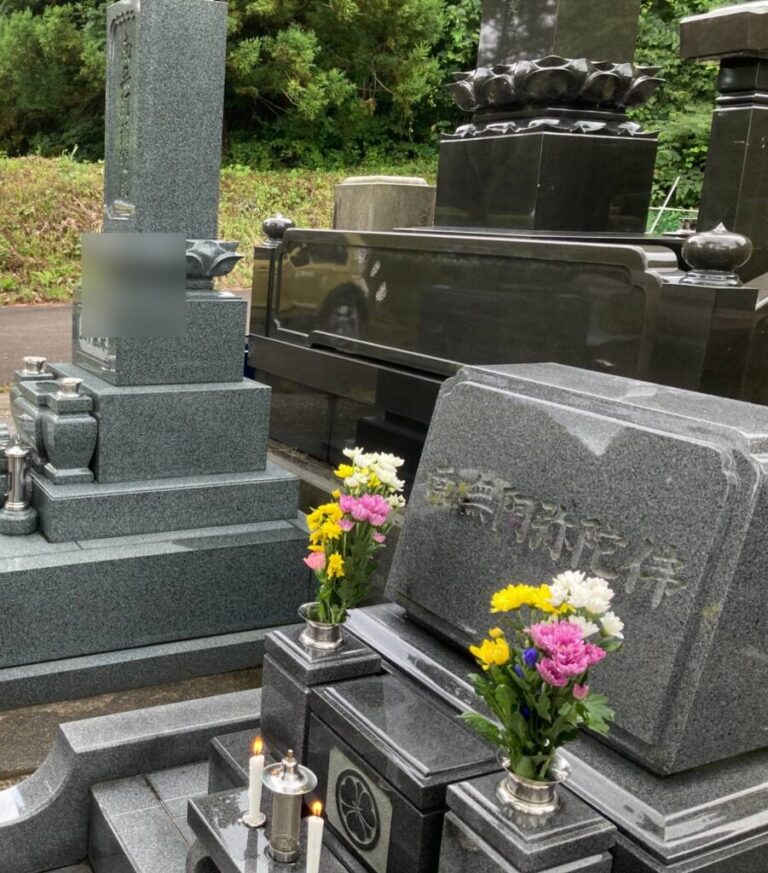
I built the grave for my parent and paid all 1.3 million yen myself. 300,000 yen for the land and 1 million yen for the stone. I did not split the cost with my relatives.
The law has no rule about who pays. Each family has to decide.
Why do we make graves in the first place?
Respect for the dead? A culture of honoring ancestors? Honestly, I do not really know. My mother told me, “Build it here.” So I built it. That is all.
To be honest, I also had the feeling of “after I built it, then what?” But the real problem was that it cost 1.3 million yen. In this article, I talk about the breakdown of the cost, and about both sides: building and not building. I also talk about who builds and who pays, using my own family as the example.
I will say this honestly first. Now I regret it. Maybe I only followed what was “normal” back then. I will write the reason at the end of this article.
- The Cost of the Grave: 300,000 Yen for Land, 1 Million Yen for Stone
- Why I Built It
- Who Pays for the Grave? In My Family, I Paid for All of It
- Not Building, Option 1: Eitai Kuyo
- Not Building, Option 2: Scattering the Ashes
- The Reality After Building It
- My Honest Feelings About Visiting the Grave
- What Worries Me Is My Children
- Building or Not Building: Which Is Right?
- What I Regret About Building the Grave
- Summary
The Cost of the Grave: 300,000 Yen for Land, 1 Million Yen for Stone
The town office was selling plots in a cemetery. The price depended on the size.
| Item | Cost |
|---|---|
| Land (4 square meters) | 300,000 yen |
| Gravestone | 1,000,000 yen |
| Cemetery management fee | 2,000 yen per year |
| Total | 1,300,000 yen |
There were two kinds of land: 4 square meters for 300,000 yen, and 6 square meters for 450,000 yen. I chose a simple gravestone. Even so, it cost 1 million yen.
For the land, I applied when the town office called for buyers, won the lottery, and was able to buy it. I could not get the plot number (position) I wanted. But while my mother was still alive, she and I chose a convenient spot, right next to a water tap. You use water to clean a grave. Being close to the water tap matters more and more later.
Why I Built It
Before my parent died, my parent asked me, “Build it here.” It was something like a last will.
Because of those words, there was no room to hesitate. However much it cost, keeping the promise to my parent came first.
I want to think “it is not about money.” But in reality, it was money. The number 1.3 million yen follows me all the time.
Who Pays for the Grave? In My Family, I Paid for All of It
There is no fixed rule. When I looked it up, the law (Article 897 of the Civil Code) only says who takes over the grave and the Buddhist altar. It does not say who builds it or who pays. Each family has to decide according to its own situation.
In my case, my mother asked me, so I built it, and I paid all 1.3 million yen myself. I did not share the cost with my relatives.
One of those relatives said this to me: “You do not have to push yourself to build it. If you build it, borrow money, and then cannot feed yourself, it will be hard later.”
I think that is right. More than who builds it, what comes first is that the life of the person who builds it does not break. A parent will not be happy with a grave built with borrowed money.
Not Building, Option 1: Eitai Kuyo
The temple also had eitai kuyo graves. Eitai kuyo means the temple takes care of the remains and the memorial services for you. It works with a yearly fee, and you can keep the cost down.
But the bones get mixed with the bones of other people. That bothered me. I could not wipe away the feeling that it was sad for my parent. My resistance to putting my parent in the same place as strangers is not logic. It is emotion.
Not Building, Option 2: Scattering the Ashes
Another option is scattering the ashes at sea. But at that time, I did not know much about it. I also had no connection to a company that does it.
Now there are more companies that offer ash scattering. If I had known, it might have been one of my options.
The Reality After Building It
I go three times a year. Cleaning before Obon, visiting on the day of Obon, and tidying up after. Three times in total. Obon is a few days in summer in Japan when families visit the graves of their ancestors.
I feel I should at least go at Obon. At Obon, I clean the grave with my wife and my second son. The names of everyone in my family are also carved on the grave.
The relatives do not come. I have never seen flowers put there by anyone else. That is the reality.
My Honest Feelings About Visiting the Grave
I feel a little sorry that I can only go a few times a year. But I do not feel anything special in front of the grave.
Cleaning before Obon feels like a way to make up for it. When I get it clean, it feels good. Maybe that is all. But I also think that is fine.
What Worries Me Is My Children
It may become a burden on my children. After I die, my children will have to keep taking care of it. When you build a grave, you need to keep in mind that it does not end with one generation.
There is also the option of hakajimai, closing the grave. In recent years, with more old people and fewer children, more families can no longer keep a grave. It is realistic to think about it from the time you build, all the way to closing the grave in the future.
It is not only the grave. If you think about the funeral and what comes after while you are still healthy, it is easier for your family.
Building or Not Building: Which Is Right?
| Build | Do not build (eitai kuyo, scattering) | |
|---|---|---|
| Cost | High (over 1 million yen) | Can be kept low |
| Care | Continues | Left to the temple or others (some charge a yearly fee) |
| Feelings | There is a place to settle down | Depends on the person |
| Burden on children | Remains | Small |
| Wish of the parent | Easy to grant | May need to persuade |
There is no right answer. The wish of the parent, the cost, the burden on the children, the feelings. You can only weigh all of it and decide.
What I Regret About Building the Grave
Finally, I will write what I really think.
Some good came from building it. At Obon, my wife, my second son, and I clean the grave together. That became a rule of our family. The grave did become a place where my family gets together a few times a year. That is true.
Even so, now I regret it.
I built it in 2016. Back then, I believed “a grave is something you build.” My parent told me so, and it was drilled into me as normal.
Now it is different. While I was studying money, the world also changed. Scattering ashes at sea, shared graves, more people who do not have a grave. The air is completely different from back then.
It is not that I regret spending the 1.3 million yen. It is that back then, I did not think with my own head and just followed what was “normal.” That is what bothers me now. Common sense is only the air of that time and that place. It changes in 10 years. I learned that through my own life.
Summary
I recommend that families talk and decide whether to build a grave while the parent is still alive. Just having a rough idea of the cost will keep you from panicking when the time comes.
I have regrets. But I cannot go back. Since I built it, I will take care of it. That is all.
One piece of homework is left. I have not yet talked with my children about whether they will take it over. Someday, I have to decide.
コメント