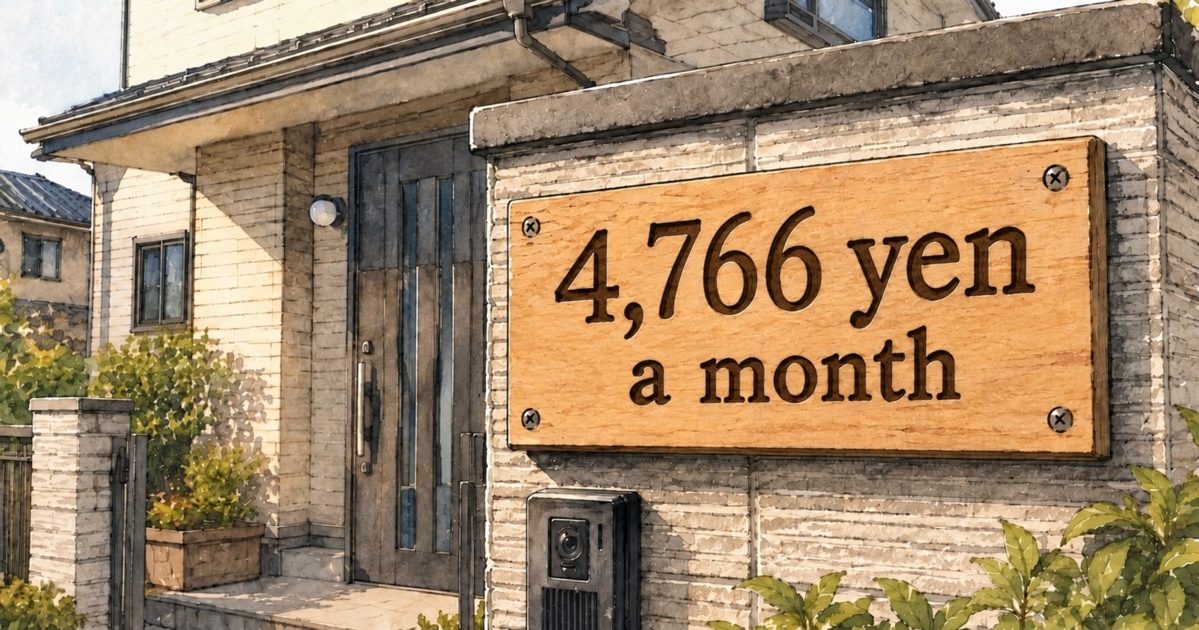
My fire and earthquake insurance for my house comes to 4,766 yen a month. Fire is 3,693 yen and earthquake is 1,073 yen. Together, 4,766 yen a month.
It is a 34-year-old house in a snowy rural area of Japan. If you have ever asked yourself, “Is my fire insurance a fair price?” please read on. I will show you everything in my policy.
- Everything in the insurance I have now
- The 30,000 yen deductible does not change with the type of accident
- Why I chose Mitsui Sumitomo Insurance
- I read Okane no Daigaku and looked at my insurance again
- My conclusion: keep fire, think about home contents, keep earthquake for now
- The 20 million yen set for the building
- Why I paid for 10 years and 5 years at once
- In the end, I keep this insurance
Everything in the insurance I have now
It is “GK Sumai no Hoken Super Long” from Mitsui Sumitomo Insurance. This is what is in it.
| Item | My policy |
|---|---|
| Fire insurance premium | 3,693 yen a month (443,150 yen paid at once for 10 years) |
| Earthquake insurance premium | 1,073 yen a month (64,380 yen paid at once for 5 years) |
| Total | 4,766 yen a month |
| Coverage for the building | 20 million yen (earthquake: 10 million yen) |
| Coverage for home contents | 5 million yen (earthquake: 2.5 million yen) |
| Deductible | 30,000 yen |
| Building age discount | 10% |
| Building | 34 years old, about 175 square meters (53 tsubo), H-class structure (not fire-resistant) |
It has every type of coverage. Fire, lightning, explosion, wind, hail and snow, water leaks, theft, floods, accidental damage, and earthquake, volcanic eruption and tsunami. Think of it as “every disaster that can happen to a house.”
The 30,000 yen deductible does not change with the type of accident
The “30,000 yen deductible” in the table means 30,000 yen for any accident. It is the same for a water leak, or for something I break by mistake. But if more than 80 percent of the floor area burns down or is destroyed, this 30,000 yen is not taken off. The full 20 million yen for the building is paid.
I found something while looking into this. People who join this insurance now get different terms. The current version, for contracts that start on or after October 1, 2025, says that for water leaks and accidental damage only, you pay the first 50,000 yen yourself. The papers from 2017, when I joined, do not have that line.
Even with the same company and the same product name, where they draw the line changes with the year you signed. It is better not to apply the fire insurance story of someone else straight to yourself. My 30,000 yen may not be your 30,000 yen.
Source: Mitsui Sumitomo Insurance, “Explanation of Important Matters,” for contracts starting on or after October 1, 2025, and the same document for contracts starting on or after January 1, 2017
Why I chose Mitsui Sumitomo Insurance
Some time after I built the house, I had fire and earthquake cover through “Tatemono Kosei Kyosai Muteki” from JA Kyosai. JA Kyosai is the insurance arm of the Japan Agricultural Cooperatives. It was a 10-year contract from 2007. It was a savings type, and it paid out a maturity benefit every 10 years.
In 2017, the 10 years ended. For the building and home contents together, a good sum of money came back to me.
Right then, a salesman from a local agency came. “If you put this maturity money into a long-term lump-sum payment, it will be cheaper in total.”
I did as he said and moved my fire and earthquake insurance to Mitsui Sumitomo Insurance. I paid in one lump sum for a 10-year contract, with automatic renewal for a total of 20 years.
At the same time, the same salesman also offered me life insurance and cancer insurance, and I signed up. Looking back, the maturity money opened the door to the sale. It was all part of his sales flow.
By the way, I later had trouble with this salesman in another case. When I was in a car accident where I was 0 percent at fault, I could not rely on his support. That is what made me move my car insurance to JA Kyosai.
My fire and earthquake insurance is still with Mitsui Sumitomo Insurance today.
I am only writing about what happened to me. I am not saying the salesman is bad, or JA is bad, or Mitsui Sumitomo Insurance is bad. If reading this makes you take a fresh look at your own insurance, I will be glad.
I read Okane no Daigaku and looked at my insurance again
I read about the approach to insurance in Okane no Daigaku (a Japanese introductory book about money, first published in 2020), and I reviewed my own insurance.
The idea is simple.
Use insurance only for “low chance of happening x big loss.” For everything else, use savings.
The book says these three are the ones to cover with insurance.
- Fire insurance (your house burns down)
- Car insurance (only unlimited cover for injury to people and damage to property)
- Term life insurance with no savings part (only for families with small children)
About earthquake insurance, the book says this: “It fits low chance x big loss, but it is hard to get paid, so it is not recommended.”
After reading this, I looked at my insurance again.
My conclusion: keep fire, think about home contents, keep earthquake for now
After looking at the ideas in Okane no Daigaku, I sorted out my insurance like this.
1. Fire insurance: keep it
This matches what Okane no Daigaku says. My house is the biggest asset of my life. If I lost it all to a fire or a flood, I could not rebuild it with my own savings. For a disaster that “rarely happens, but ends everything if it does,” I keep insurance.
2. Household goods cover of 5 million yen: thinking about dropping it at the next renewal
Household goods cover is not one of the three in Okane no Daigaku. It is only a few hundred yen a month, but some also point out that “there are few times you would use it.” At the next renewal, I plan to think about whether to drop it.
3. Earthquake insurance of 10 million yen: keep it for now
Okane no Daigaku says, “It is hard to get paid, so it is not recommended.” It is true the conditions for payment are strict. After the Noto Peninsula earthquake, what I received was 500,000 yen, for damage judged as partial (5 percent of 10 million yen). But where I live, the ground could shake at any time. I understand the sound argument. But when I think about my own region and my own age, I am not yet convinced. For now I keep it. I will think again at the next renewal. I wrote about my honest reasons for keeping earthquake insurance in another post, linked below.
Each person decides for themselves. What matters, I think, is to think for yourself and make your own choice.
The 20 million yen set for the building
The coverage for the building is 20 million yen. It is a 34-year-old house of about 53 tsubo, or about 175 square meters. The 20 million yen is probably what the house cost when I built it. I do not remember the details. I thought that was the right number.
But later I found out that at prices today, 20 million yen would not build even half of a house the same size.
Why I paid for 10 years and 5 years at once
I paid 10 years of fire insurance at once, and 5 years of earthquake insurance at once. The big payment at the start was about 510,000 yen in total.
Paying at once saves tens of thousands of yen compared with paying monthly. My rule is “pay when I can.”
Of course, it was a heavy expense at first. But once I have paid for 10 years in advance, I do not have to worry about insurance for a while. That is easier than I expected.
In the end, I keep this insurance
Fire, 3,693 yen. Earthquake, 1,073 yen. Together, 4,766 yen a month. I pay for earthquake insurance twice in 10 years, so over 10 years I pay about 570,000 yen in total. A house 34 years old, building 20 million yen, home contents 5 million yen, earthquake 10 million yen.
This is what I chose after looking at the ideas in Okane no Daigaku. Keep fire. Think about home contents at the next renewal. Keep earthquake for now too.
My house is the biggest asset of my life. I buy the insurance that protects it for 4,766 yen a month. I think that is cheap.
What does your insurance protect, and what do you choose not to cover?
Note: I once added this up wrong as 4,331 yen a month. The correct total is 4,766 yen a month (fire 3,693 yen + earthquake 1,073 yen). I checked my insurance policy again to be sure.
More about insurance and money after 60 in Japan:

Comments