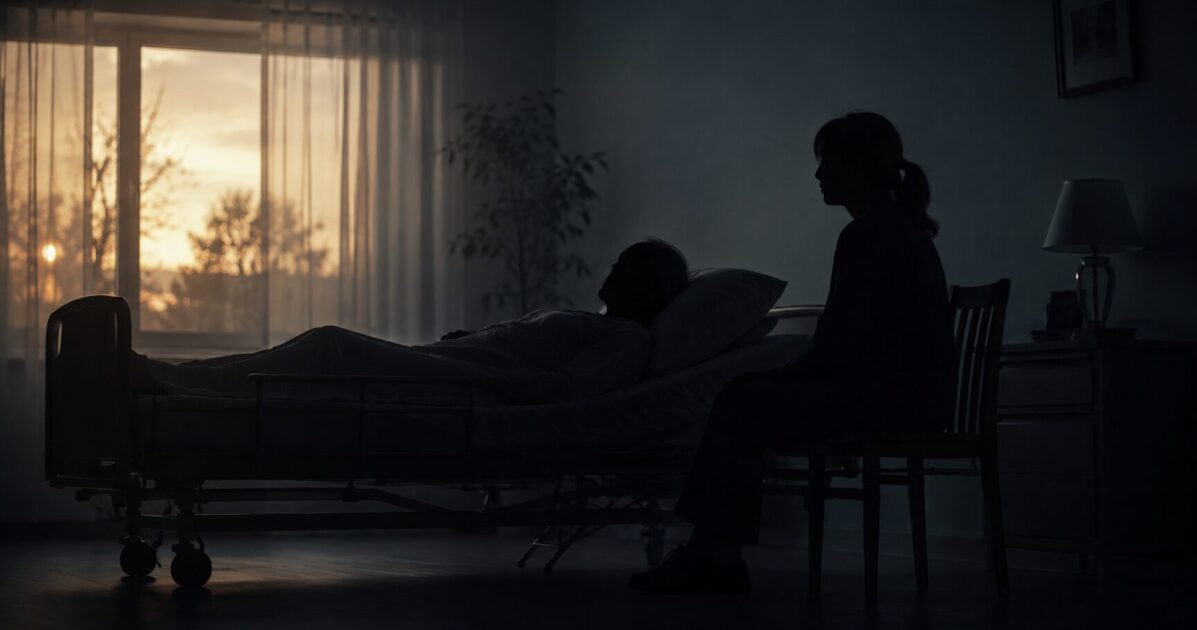
“I cannot do this anymore.”
If you are caring for a parent at home, you have thought this at least once.
My mother collapsed in 2010. The care lasted 5 years. Only the last 3 months were in a nursing home, and that is where she died.
After 5 years, I reached two answers. Just two.
1. Do not carry it alone. Take everything to the care manager. If the fit is bad, change to a new one, fast.
2. Listen to your parent while your parent can still talk. About anything.
That is all of it. Why do I say this? Here are my 5 years.
The day the hospital said, “We cure illness. We do not give care.”
My mother had heart surgery in 2010.
In the final step, the doctors were supposed to pull out a thread that had been passed through the body. It seems the thread was sewn to the aorta. The moment they pulled, the vessel tore. Massive bleeding. A second operation. Two 10-hour surgeries, one after the other.
Her strength dropped all at once. After the surgery came a stroke, and her left arm stopped moving. The heart did not recover well, and she could not get off the ventilator. It took 3 to 6 months to remove it, and she still had trouble breathing. She stayed bedridden. Even with rehab, she could not walk on her own. There was one more operation, to put a device in her body that gives an electric shock if the heart stops.
Six months at the first hospital. A transfer, then six more months. Then the second hospital also told us she could not stay much longer.
“A hospital is a place to cure illness. It is not a place to give care.”
When I heard that, my mind went blank.
I found a care manager before discharge, not after
The textbook says: go to the city office and apply for long-term care insurance. I barely remember that part. My mother had a disability certificate, so I think the care manager did the paperwork for us.
What I did was this. A nurse I knew introduced me to a care manager — in the Japanese long-term care system, a care manager is the person who plans and arranges all the services. I did this before discharge. If you start looking for one after the patient comes home, you are already late. Home care starts that same day.
When should you start? Any time during the hospital stay. If something worries you, ask right away. Asking calms you down. But the result of the care level certification comes within 30 days of applying, as a rule. So the guide is to start more than 1 month before discharge. The hospital has a medical social worker, at a desk with a name like “medical consultation room.” It is fine as the first place to ask.
Before discharge, the care manager, my wife and I sat down and went through it all: the care bed, the toilet, diapers, meals, what the day service center does. A day service center is a place where an elderly person spends the daytime and gets care. How to get diapers cheaply, buying a portable toilet — the care manager taught us all of it.
This is the first answer I reached. I took every problem, every unpleasant thing, to the care manager. A family that keeps it inside goes nowhere. Leaning on a professional is allowed.
Day service was not enough. We hit the wall fast
At first we used the day service center, 9:00 to 16:00. I thought, now we can rest during the day.
Wrong. She left at 9 and came back at 16. It goes by in a blink. The morning preparation and the evening care ate the whole day anyway.
We used overnight respite stays too, 3 or 4 days at a time. Still not enough. Talking with the care manager, we kept stretching the stays. In the end it was around 20 days a month, I think. I do not remember exactly.
The only way we survived was to arrange the care so my mother was home as little as possible.
Every 10 to 15 days, she came home for one day. That one day was brutal. Meals, toilet, diaper changes. She wanted to sit on the toilet, to pee and to poop.
I will write this honestly. The toilet and diaper care — I pushed it onto my wife. I ran away from it. Even now she brings it up sometimes. I just sit and listen. I cannot argue back.
Money was tight. But we made it, because my mother had some savings, and that is what carried us. I do not know what we would have done without it. After the move to the nursing home, her pension covered the cost, as I remember it. In the months of short stays, I think we paid around 100,000 to 150,000 yen a month. I would need the old bankbook to be exact.
People say home care in Japan is cheap. The survey number is around 53,000 yen a month. That number does not count the family. Not one yen for the hours, not one yen for the strain. Home care looks cheap because the family works for free. Five years, and my wife and I were paid nothing.
Care managers are not all the same. I learned you can change them
After 5 years I can say this: care managers are not all the same. Some are a good fit, and some are not.
If the fit is bad, you can change. In Japan the desk for that is the community comprehensive support center, a public consultation desk for elderly care. It feels rude. It feels like you are being cruel to someone. I felt that too.
But this is a long war. Mine was 5 years. There was no room to fight it with the wrong partner.
And one more honest thing. When it goes on for years, a day comes when you think, even about your own parent: please die soon. I thought it. Then I blamed myself, and told myself, no, this is how I honor my mother. Then I thought it again. That loop, over and over.
My biggest regret, and the two answers again
Three months before the end, my mother entered a special nursing home, and died there.
Looking back now, my biggest regret is this: I should have listened while she could still talk. The old days, favorite things, stories from being young. Anything would have been fine.
After the collapse, she was bedridden for 5 years, and almost no real conversation was possible anymore.
So, one last time, the two answers I reached after 5 years.
1. Do not carry it alone. Take everything to the care manager. If the fit is bad, change to a new one, fast.
2. Listen to your parent while your parent can still talk. About anything.
What stage are you at now? If your parent is still in the hospital, talk to the medical social worker at that hospital, even tomorrow.


コメント