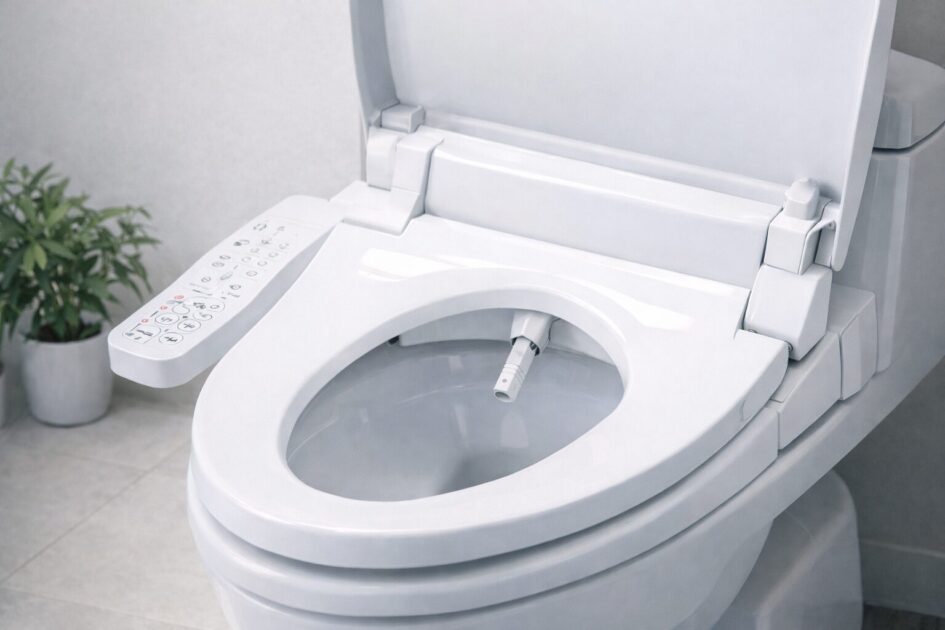
When the toilet seat breaks, do you choose a plain heated seat or a Washlet? Washlet is the name people in Japan use for a toilet seat with a built-in bidet. And how much does it cost? I will write what our home, after 29 years of use, actually chose.
I will say the answer first. Our home chose a simple heated seat, not a Washlet. These are the two reasons.
- Cleaning the nozzle is a bother
- A Washlet costs more than a normal seat
I will also write the money first. A heated seat alone was about 20,000 yen with labor. With a Washlet, it was close to 50,000 yen. The difference was about 30,000 yen.
One day, the toilet seat on the first floor suddenly broke. Before I knew it, I had used it for 29 years.
It was the cold season in December, so there was no room to hesitate. Above all, “a cold seat is the one thing we cannot have.” I asked for a replacement right away.
- The Lifespan of a Toilet Seat Is About 10 Years, but Ours Lasted 29
- Why I Gave Up on a Washlet: Who Will Clean the Nozzle?
- The Cost of Replacing a Toilet Seat: 20,000 Yen for a Heated Seat, 50,000 Yen for a Washlet
- In the End, I Chose a Heated Seat: How I Saw the 30,000 Yen Difference
- A House Grows Old Quietly
The Lifespan of a Toilet Seat Is About 10 Years, but Ours Lasted 29
First, what surprised me was that it lasted 29 years at all. It was the standard seat that came with the house when we built it in 1992. It was not a high-end item. It was a very ordinary heated seat.
It never had trouble even once. Of all the equipment in the house, it may have been the one that needed the least care. Then suddenly, the power would not come on. It had worked normally until the day before.
A cold toilet seat in December is a small thing, but it is hard to bear. Every time I sat down, I went “ugh.” Everyone in the family looked unhappy.
When I looked it up, the lifespan of a heated seat or a Washlet is said to be about 10 years. The manual of the new seat also said “the lifespan is about 10 years.” Ours lasted 29 years, so that is close to 3 times the guideline.
To be honest, I do not remember doing anything special to make it last. I just used it normally and cleaned it normally. I do not know myself why it lasted this long. But I can say that even an ordinary standard item can last this long sometimes. “A 10 year lifespan” is only a guideline. I think it changes a lot with how you use it and with luck.
Why I Gave Up on a Washlet: Who Will Clean the Nozzle?
The contractor suggested, “How about a Washlet?” Honestly, my wife looked like she wanted a Washlet.
But when we got the estimate, they explained how to care for the nozzle, and that stuck with me. Cleaning the nozzle, changing the filter, removing limescale. I also heard that if you leave it, germs grow. It seems you cannot use it cleanly unless you keep up the care.
And that care would surely become my job. I asked my wife, “Will you clean the nozzle?” My wife said, “No, I do not want to.” I thought, so that is how it goes. More than anything, I hate things that are a bother.
The Cost of Replacing a Toilet Seat: 20,000 Yen for a Heated Seat, 50,000 Yen for a Washlet
When I line up the costs, it looks like this.
- With a Washlet: the unit is 30,000 yen or more, plus labor, close to 50,000 yen in total
- Heated seat only: the unit is between 10,000 and 20,000 yen, plus labor, about 20,000 yen in total
The difference is about 30,000 yen.
Buy comfort for 30,000 yen, or keep it simple?
When I was young, I might have picked a Washlet without a second thought. But in my 60s, I think about “repairs when it breaks,” “the work of cleaning,” and even “when the next replacement comes.” I can no longer decide only by convenience.
The care is a bother, and the price is high too. A heated seat alone is close to 30,000 yen cheaper than a Washlet. There was no reason to force myself to pick something that costs both work and money.
In the End, I Chose a Heated Seat: How I Saw the 30,000 Yen Difference
I learned this later when I looked it up, but it seems today the Washlet has come a long way. Some wash the nozzle automatically every time you use them, and some even kill germs on their own after 8 hours of no use. It seems the care is much easier than before. But I do not know if those functions existed when I replaced mine. At least at the estimate, I was told that care was needed. Even if it had become easier, I put the bother first, so I think I would probably have made the same choice.
My wife looked a little let down, but in the end, we agreed, “Simple is fine this time.” We were in a hurry, and the first thing was to do something about the cold seat.
I asked a contractor to do the replacement. The work took less than 30 minutes. It was over before I knew it. Something we used every day for 29 years became new in only 30 minutes.
When she sat on the new seat, my wife said, “It is warm.” It is a normal thing, but only after it breaks do you understand how good “a warm seat” is. People often notice things only after they lose them. It was the same with my teeth.
By the way, when I looked at the old seat that was taken off, the back side was quite dirty. It was 29 years of dirt. I pretended I did not see it.
If this seat follows the guideline, the next time it breaks will be 10 years later, maybe when I am in my late 70s. By then I may have a Washlet. I can decide when the time comes.
A House Grows Old Quietly
The toilet on the second floor has not broken yet. But the equipment of a house reaches the end of its life suddenly one day.
Before this, I also replaced the bathroom sink. I had the roof painted too. A house grows old quietly, and then one day a big expense comes.
When a house is over 30 years old, things start to go wrong here and there. It is the same as my own body. Something I thought was “still fine” suddenly stops working one morning.
So it is better to always keep some repair money in mind. If you decide in a panic, it can lead to extra spending. In our home, it has been the water heater, the roof, the bathroom sink, and then the toilet seat, one after another. I do not know what will break next, but there is no doubt that the next turn will come. In a house over 30 years old, the equipment breaks one by one, like people waiting in line.
The toilet seat alone was only 20,000 yen. But the water heater and the roof are not like that. Even one water heater is 130,000 to 150,000 yen if it has a reheating function, and an EcoCute heat pump water heater is over 470,000 yen. From here on, costs far bigger than the 20,000 yen seat will come, one by one.
This time with the toilet seat, we were in a hurry, but I could make a simple decision. Talk with the family and make a choice that fits our means. I think living in my 60s is a pile of things like that.
Another thing I have written about my old house:
Comments