In 2025, my public pension put about 2.42 million yen into my bank account. That is about 200,000 yen a month. It comes every two months, about 390,000 to 410,000 yen each time.
A small company pension adds about 137,000 yen a year.
For a Japanese man who worked for a company, the average public pension in fiscal 2024 was about 170,000 yen a month. I get more than that. But about 400,000 yen a year of mine is an extra amount for my wife, and it stops in 2030.
My Japanese pension, line by line
These are the yearly amounts in my own notes, before deductions, rounded. They are from an earlier year, so they do not match the 2025 deposits exactly.
| Part | Per year | Note |
|---|---|---|
| Employee Pension (kosei nenkin) | about 1,205,000 yen | From a little more than 528 months in it |
| Spouse supplement (kakyu nenkin) | about 400,000 yen | Stops when my wife turns 65, in 2030 |
| Basic pension (kiso nenkin) | about 816,000 yen | The national base part |
| Company pension | about 137,000 yen | Drops to about 93,000 yen from 2037 |
Before the public pension reaches my bank account, long-term care insurance, income tax and resident tax are taken out of it. The 2.42 million yen at the top is what actually arrived.
My pension was bigger than my rehire salary
After 60, I kept working at the same company on a rehire contract.
The rehire pay was depressingly low. I still carried a fair amount of responsibility, yet I may have been paid less than a new hire. I could do more than a new hire, and I could teach them too. How could anyone feel motivated like that? The system is full of contradictions.
My pension was more than my rehire salary. Working for less than I would get without working felt foolish. So I decided to quit.
“Wait a minute”
I had connections at the top. The president and some of the department heads had held the same rank as me when I was promoted. The factory manager and I somehow got along.
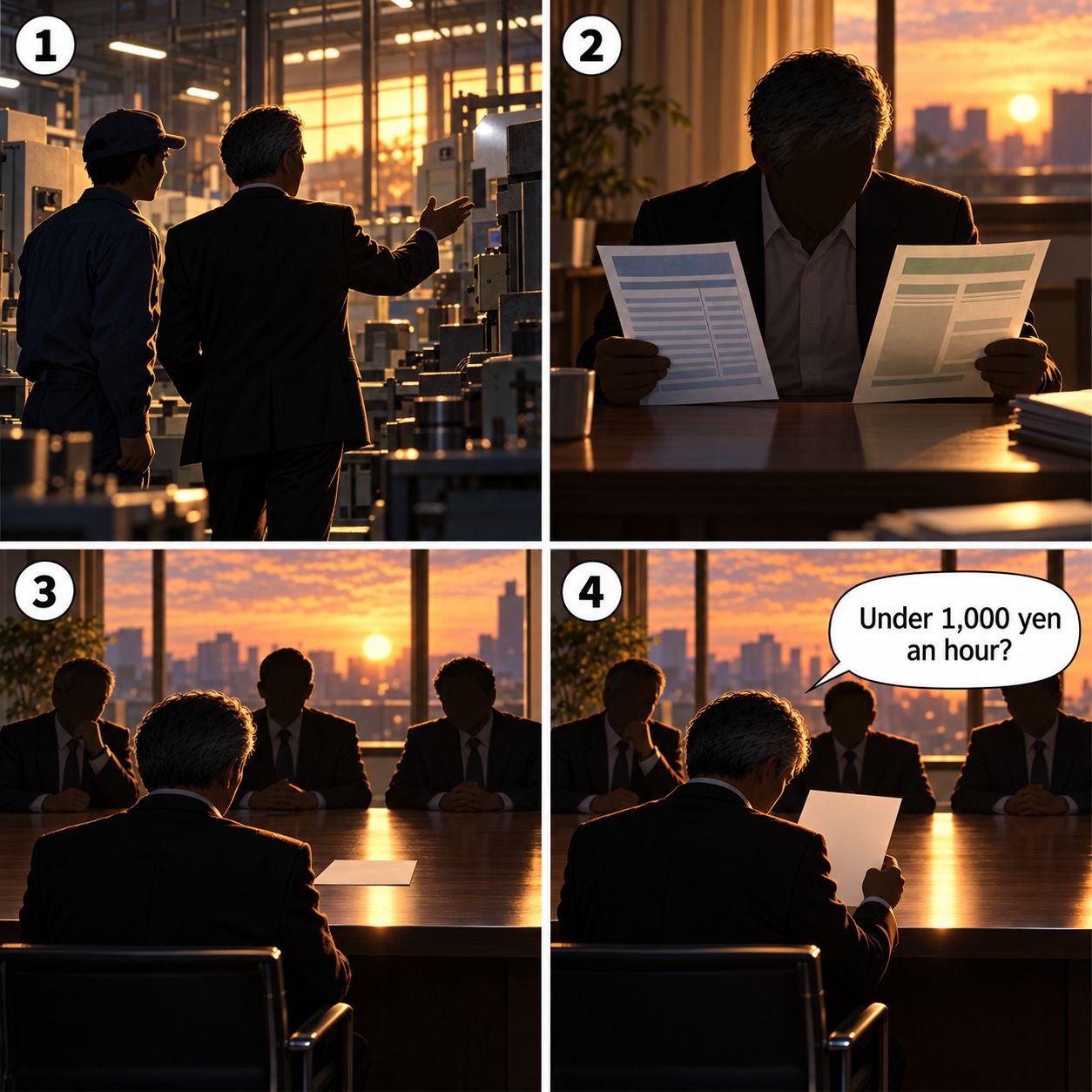
I went through the proper line first. My team leader, my section chief and my manager all knew. After that, I went to the people at the top to say goodbye myself: “I am leaving at the end of this month.”
“Wait a minute,” they said. It turned into a meeting with the head of general affairs, the head of production and the president. My own bosses were not part of it. As a part-timer, my placement would change anyway.
I told them I was tired of it and I was leaving. But I said I would do part-time work, three days a week or so, if they wanted.
The hourly pay they offered was under 1,000 yen. I could not believe it. If you ask a man to stay, I thought, it should be 2,000 yen an hour.
I talked to the factory manager about it. But the general affairs side would not bend. I think they did not want to set a precedent. There was nothing more to do.
In the end I worked part-time for about 1,000 yen an hour. It came to about 50,000 yen a month. I did that until March 2025.
What leaving added to my pension
Japan counts the pension in months. I started at a company in April 1977, at 18, and by 2021 I had paid into the Employee Pension for 528 months, which is 44 years.
For men my age, the earnings-related part of the pension starts at 63 either way. But with 44 years, once you leave the Employee Pension, two more things are added from 63: the flat-rate part, and the supplement for a spouse.
My rehire job kept me inside the Employee Pension. The part-time job did not. So when I left the Employee Pension, around 2022 at 63, those two parts were added. In the end I paid in for a little more than 528 months.
My wife and the pension
While I worked, my wife was covered by the pension system as the wife of a company worker. In that position she did not have to pay her own pension premiums.
When I left, that ended. She was still under 60, so she had to pay into the National Pension herself until 60. In our house, I paid it. My ledger shows about 17,000 yen a month, until she turned 60 in 2025.
My pension has the spouse supplement while my wife is under 65.
In 2030 the supplement stops, but our household gets more
My wife turns 65 in July 2030. After that, the spouse supplement of about 400,000 yen a year stops.
From 65, her own pension is about 930,000 yen a year.
So our household pension goes up, not down. From about 2.56 million yen a year now (before deductions, with the company pension), to about 3.09 million yen. From 2037, when my company pension gets smaller, about 3.04 million yen.
A count of months
In the end, it came down to a count of months, a meeting with the president, and a household ledger.
My pension comes every two months. When it does, I write it down.
More about money and work after retiring in Japan:
- Working After Retirement in My 60s: I Turned Down a Job in Japan
- Japan National Health Insurance Cost: What I Pay at 67, and Why I Kept My Company Plan First
- Pension and the Final Tax Return in Japan: I Got Back 10,000 to 30,000 Yen
- Kokumin Nenkin Tsuinou: I Paid 600,000 Yen of Back Pension for My Child
Comments