Shohei Ohtani made a mandala chart in his first year of high school. It has 81 squares. In the center, he wrote his goal: “To be selected in the first round of the draft by 8 teams.” Every time I hear that story, something about it bothers me a little.
I do not have a dream like the one in that center. Even when I was 14, I had no picture of what I would become.
Still, in my 60s, there is something I wrote on paper. It is not a dream. It is money coming in and going out.
- I Have No Goal to Write on a Mandala Chart. I Did Not Have One at 14 Either
- The Plan at the Company Was “Achieve This Number”
- In My Life Plan in My 60s, I Wrote Amounts of Money, Not Dreams
- The Answer I Got Was Only “Do Not Spend More Than Comes In”
- I Put “Money In and Money Out” in the Center and Filled Nine Squares
- One Area to Grow Went Into a Business Start-Up Plan
- It Was Not Something to Write Once and Be Done
I Have No Goal to Write on a Mandala Chart. I Did Not Have One at 14 Either
Successful people seem to know what they will become by around age 14.
Eikichi Yazawa, a Japanese rock singer, heard the Beatles in his third year of junior high school and decided his path. Ohtani filled in 81 squares in his first year of high school.
A mandala chart is a table of 81 squares, a 9-by-9 grid. In the center, you write your biggest goal. Around it, you write 8 things you need for that goal. Then for each of those 8, you write 8 things to do. That makes 64 things to do in total.
Around the center, Ohtani wrote things like “building the body,” “mental strength,” and “luck.”
The real sheet Ohtani wrote is shown in an article by Takashi Harada, the man who made the sheet. The article is in Japanese and for members only.
I did not have one. Without one, I worked on the factory floor for 40 years.
The Plan at the Company Was “Achieve This Number”
As for plans, I did write them at the company. After I became a manager, I wrote one every six months and every year.
A company has a plan. “Achieve this number.”
The center was filled in from the start.
In My Life Plan in My 60s, I Wrote Amounts of Money, Not Dreams
About 2 years ago, I wrote a life plan.
An emergency fund. Money for future house repairs. I imagined things that might happen from now on, and put in an amount for each one.
The Answer I Got Was Only “Do Not Spend More Than Comes In”
When I finished writing, I looked at the table.
It just occurred to me: just do not spend more than comes in. That is all.
Ohtani filled 81 squares. My answer took one line.
If I can do that, I probably do not need to worry about old age.
I Put “Money In and Money Out” in the Center and Filled Nine Squares
As a test, I lined things up in the nine squares of a mandala chart. The center is “money in and money out.” Around it are the areas to protect and the areas to grow. I decide for myself which areas to protect and which to grow.
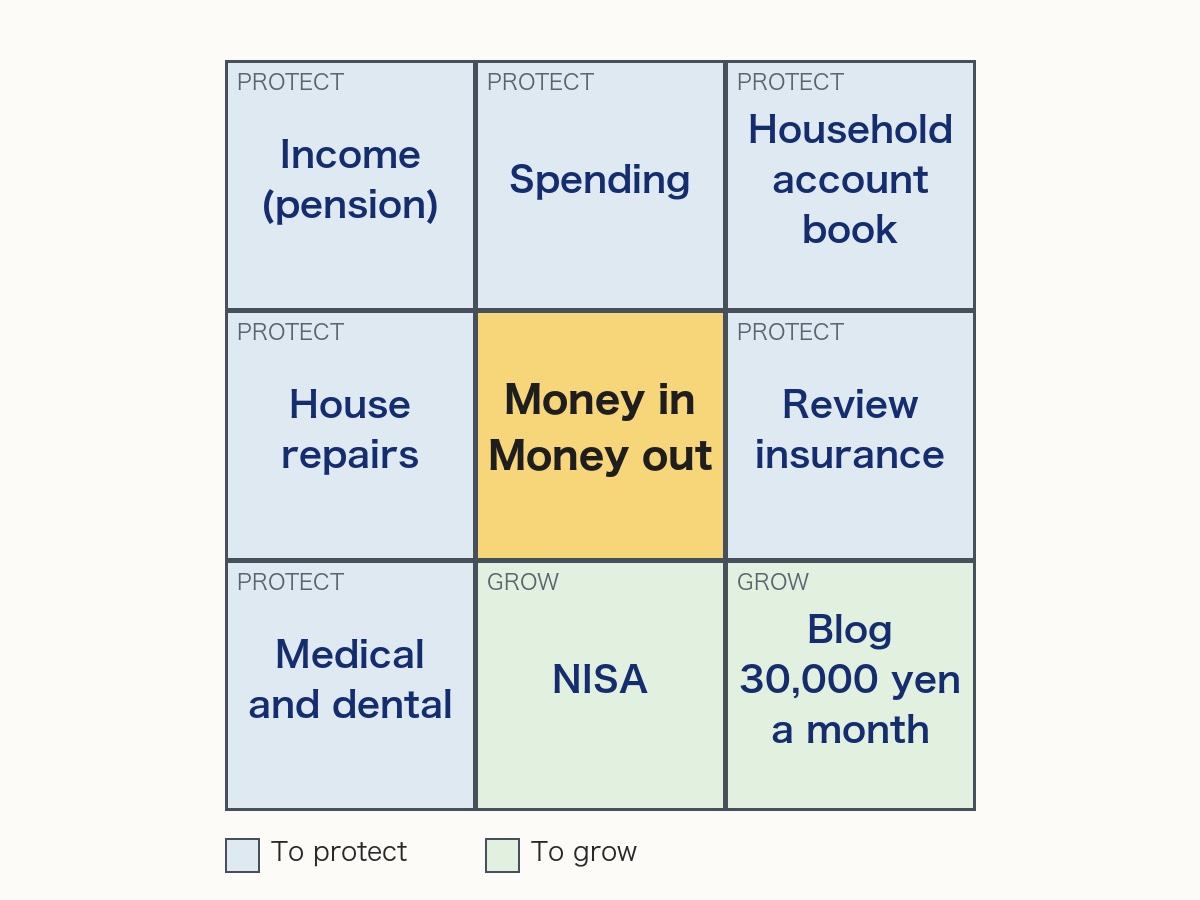
Six areas to protect, two areas to grow. Not one dream is in it.
One Area to Grow Went Into a Business Start-Up Plan
At the end of last year, I wrote one more sheet. A business start-up plan. It is a form people use to set out their plans when they start a business. I filled it in by hand while talking it over with AI.
Anyone can get the form for free from the website of the Japan Finance Corporation. It is in Japanese.
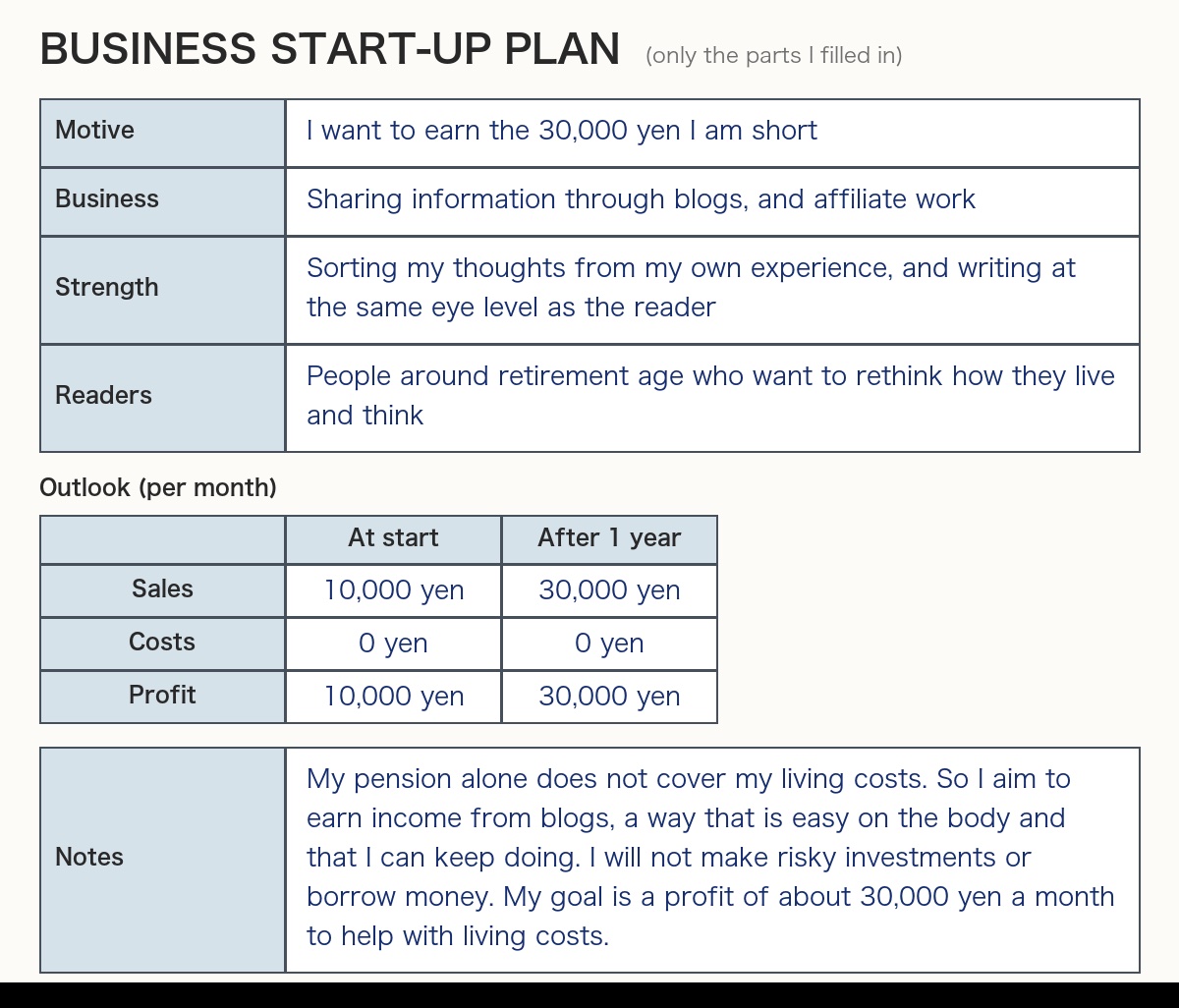
In the motive box, I wrote “I want to earn the 30,000 yen I am short.” In the last box, I wrote “My goal is a profit of about 30,000 yen a month to help with living costs.”
It Was Not Something to Write Once and Be Done
A life plan is not something you write only once.
There may be a sudden expense. Each time, I put the amounts in again.
Each time, it is a hassle.
Something else I wrote about this chart:
Comments