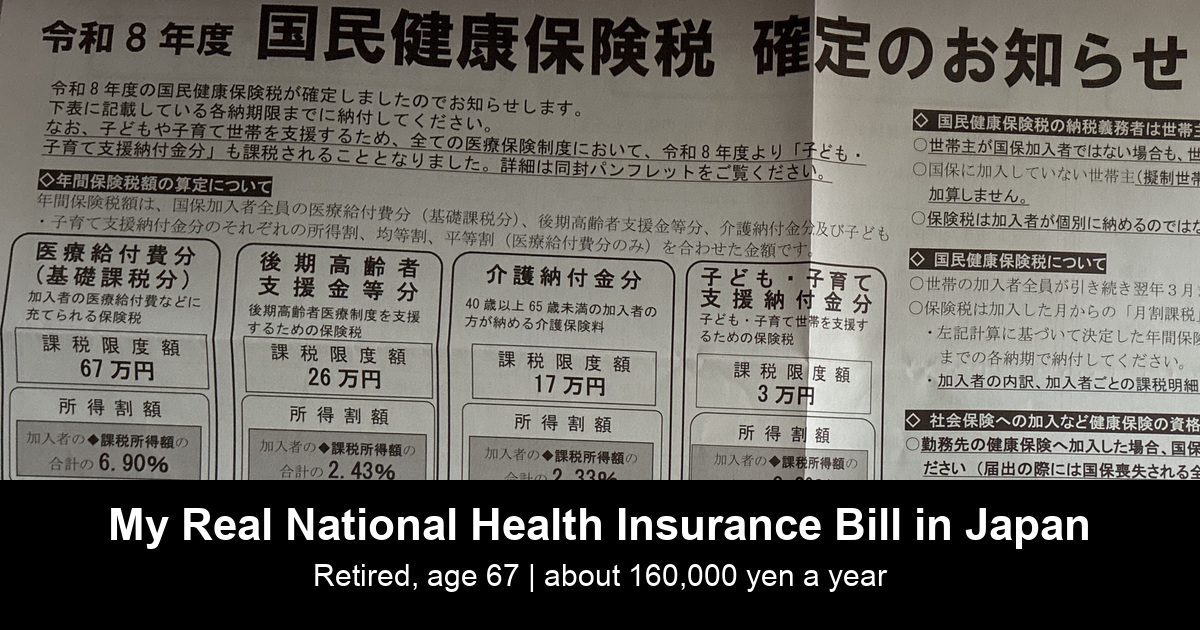
My National Health Insurance this year is about 160,000 yen. That is for me alone. I pay it by automatic bank withdrawal, in nine payments of about 17,500 yen each, from July to March.
When I retired, I did not join it right away. For two years I kept the health plan from my old company and paid all of it myself. That plan also covered my wife. In 2023, a full year on it, I paid about 270,000 yen.
These are the numbers of one household in one city. National Health Insurance is set by each city, by your income and by your family, so yours will be different.
My numbers, from my household ledger and the city notice
I keep a household ledger. Here is what it shows, with the notice the city sent me this year.
| Period | Plan | Who it covered | What I paid |
|---|---|---|---|
| About two years after I retired, until October 2024 | My old company plan, continued (nin-i keizoku) | Me and my wife | Paid every six months. In 2023: 147,661 yen and 120,461 yen. In March 2024: 100,787 yen. |
| From November 2024 | National Health Insurance | Me only | About 160,000 yen for fiscal 2026, in nine payments |
I live on the Sea of Japan side of the country. I worked in manufacturing for 40 years.
I asked the city office two or three times
Before I decided, I went to the city office and asked how much National Health Insurance would cost me. I went two or three times. The person at the counter kindly calculated it for me.
The company plan came out cheaper than the number they gave me.
National Health Insurance in my city has three parts. There is a fixed charge for each person, a fixed charge for each household, and a part based on your income from the year before. So right after retiring, the bill is usually based on a year that still had a salary in it.
The company plan worked another way. Nin-i keizoku means you keep your old company plan after you leave and pay the whole premium yourself, for two years at most. My wife was on it as my dependent, and dependents cost nothing extra. National Health Insurance has no dependents. Each person is counted.
It was not only the price
The company health insurance society also had its own health checkups and other services, different from what the city offers. I may have weighed that too when I decided.
While I was on the plan, in August 2023, my wife had hip surgery. Japan caps what you pay out of pocket each month for care covered by insurance. Beyond that, the insurance society paid us an extra benefit of its own. I remember getting about 50,000 yen.
The surgery had nothing to do with my choice. It just happened while I was on the plan.
Two years later, I moved to National Health Insurance
Nin-i keizoku ends after two years at most. In November 2024 I moved to National Health Insurance.
This year my National Health Insurance is about 160,000 yen. That is for me alone. The company plan covered my wife too, so the two numbers do not line up neatly.
What comes out of my pension, and what does not
My pension comes every two months. Before it reaches my bank account, three things are taken out of it:
- Long-term care insurance: 18,700 yen
- Income tax: 358 yen
- Resident tax (the local income tax): 300 yen
Long-term care insurance is a separate insurance for care in old age. From 65, it is usually taken straight out of the pension. National Health Insurance is not taken out of my pension. I pay it from my bank account.
My pension is about 2.4 million yen a year, or about 200,000 yen a month. For a Japanese man who worked for a company, the average in fiscal 2024 was about 170,000 yen a month. So I get more than the average. But part of mine will stop. I will come to that below.
Two more things that changed when I retired
My wife stopped being covered as the wife of a company worker
While I worked, my wife was covered by the pension system as the wife of a company worker. In that position she did not have to pay her own pension premiums.
When I retired, that ended. She was still under 60, so she had to pay into the National Pension herself until 60. In our house, I paid it. My ledger shows about 17,000 yen a month, until she turned 60 in 2025.
An extra amount on my pension that will stop
Because my wife is younger than me, my pension has an extra amount added to it while she is under 65. It is about 400,000 yen a year. When she turns 65, in 2030, it stops.
Without it, my pension would be close to the average for a Japanese man who worked for a company.
A small choice made at a counter
It came down to a few visits to the city office, a person at the counter who did the math for me, and my household ledger.
At 75, in 2034, I will move again, to the health insurance for people 75 and over.
More about money after retiring in Japan:
Comments