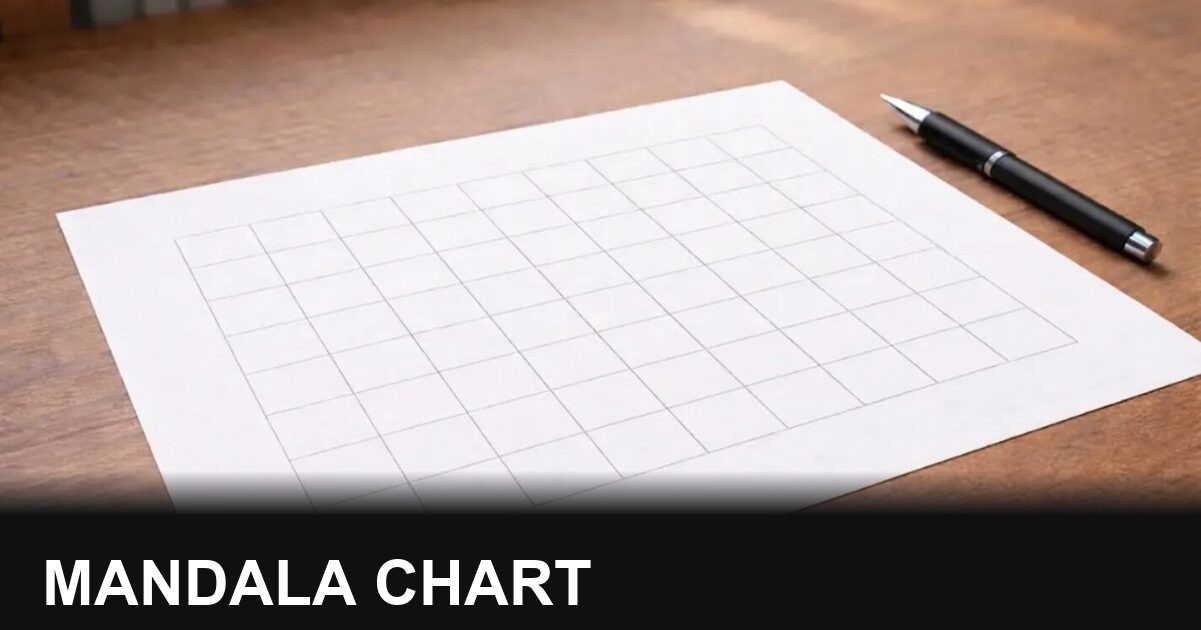
The mandala chart that Shohei Ohtani made in high school is very famous now. The big goal sits in the middle. Around it, the goal is broken into smaller pieces, and the pieces are broken into daily actions. It is so well organized that it almost looks too good to be true.
If you have not seen one: a mandala chart is a Japanese goal-setting sheet, a nine-by-nine grid of squares. The main goal goes in the center, and the squares around it break that goal down into concrete steps.
I first saw this chart many years ago. Since then, every time it comes up, a small doubt stays with me. I think it is amazing. I really do. But I also keep asking myself: is “amazing” the end of the story?
The Order of the Story Feels Wrong
Here is what bothers me. Did this chart get attention before Ohtani succeeded in MLB? Probably not. The chart became famous after Ohtani became Ohtani. The story runs backward. He succeeded, so now we look back and say the chart was great all along. Did the chart bring the success? Or did the success make the chart famous? That order has never been clear to me.
Long ago, I read a book about success. I forget the details, but it said something like this: write down on paper who you will be in three years, in five years. Make the goal visible. When I saw the chart, I remember thinking, this is the same as that book. The method is not something Ohtani invented. It is an old idea in the self-help world. And I doubt that everyone who wrote goals that way went on to succeed.
Kikuchi Must Have Written One Too. Where Is It?
One more thing I cannot let go. Did Ohtani make this chart on his own? Or was it homework that Hiroshi Sasaki, his coach at Hanamaki Higashi High School, gave to every player? My memory says there was a story like that, but I am not sure.
If it was homework, then Yusei Kikuchi wrote one too. Kikuchi came from the same school, and he is still pitching in MLB today. Same school, same coach. He most likely wrote his goals down the same way. But nobody talks about the Kikuchi chart. Was it not good enough to show the world? Or did all the attention go to Ohtani and bury it? Only Kikuchi knows.
The other day I read an article about how Kikuchi thinks. It was about a kind of sense that even AI cannot beat. To survive that long as a pitcher, he must have done a lot of thinking and had strong self-control. But his high school goal sheet never becomes a topic. Successful people always have a way of thinking. Whether it gets written on paper and stays visible to the world — that is a different matter.
The Media Ties Everything to Ohtani
His meals. His sleep. Stories from his childhood. Everything gets told in the same frame: this is why Ohtani is great. The chart feels like one more piece of that. If he had failed, nobody would ever bring up that chart.
Still, even if the coach made the whole team write one, I think there is a reason the chart Ohtani made looks so complete. A high school kid does not produce something that complete in one sitting. Maybe he looked at it again and again, thought about it, and rewrote it. So maybe the chart itself is not the point. Maybe the hours he spent facing that sheet mattered more. But that is something only Ohtani knows.
For Me, It Is a Different Story
Looking back at my own life, I stood on a factory floor for 40 years. It is not that I never wrote goals. After I became a manager, I wrote them every six months. Later, even regular workers were told to write them. But it feels like a different world from that chart. I never wrote my goals in that much detail, filling in little squares like that.
I am impressed. I mean that. But at the same time, a voice in me says: that is a different story from mine.
I think the chart is amazing. But the more the media calls it amazing, the more I want to step back and look at it from a distance. That is the honest place where I stand.


コメント