I am in my 60s.
Every day, I search for something on Google.
But lately, something bothers me.
At the very top of the search results, an AI gives an answer on its own.
I did not ask, but it shows me a summary.
I hear it is called “AI Mode.”
- I see it often on TV, but the name does not stay in my head
- I want to see information, not your interpretation
- It takes over my phone screen
- Googling, Gemini, AI Mode — the strategy is all over the place
- As a man in my 60s, I ask you to make it easier to understand
- I will think of names for you, without being asked — AskGle, TalkGle, LongGle
- Finally
- After 40 years in manufacturing, I see this as a failure
- Related
I see it often on TV, but the name does not stay in my head
A TV commercial says “AI Mode” again and again.
An actor says, “Let us ask AI Mode.”
But when the commercial ends, I forget the name.
A week later, I see the same commercial and think, “Oh, there was something like this.”
I remembered the name ChatGPT after hearing it once.
“Chat-G-P-T.” The sound stays with me.
But “AI Mode” just evaporates right away.
I want to see information, not your interpretation
The reason I search on Google is to find sources.
News articles, blogs, official websites.
I want to see a list of those URLs.
From there, I want to choose for myself, read for myself, and judge for myself.
But Google these days is different.
Before I even search, the AI gives the answer.
It runs ahead of me and says, “This is the conclusion.”
Google, I did not ask for your opinion.
I want to see information.
Not your interpretation.
It takes over my phone screen
When I search on Google with my phone, the top half of the screen is filled with the AI summary.
To see the normal search results (10 URLs), I have to scroll.
This is in the way.
It is really in the way.
I hear that thousands of people every month search for “AI Mode not needed” or “AI Mode annoying.”
So it was not just me.
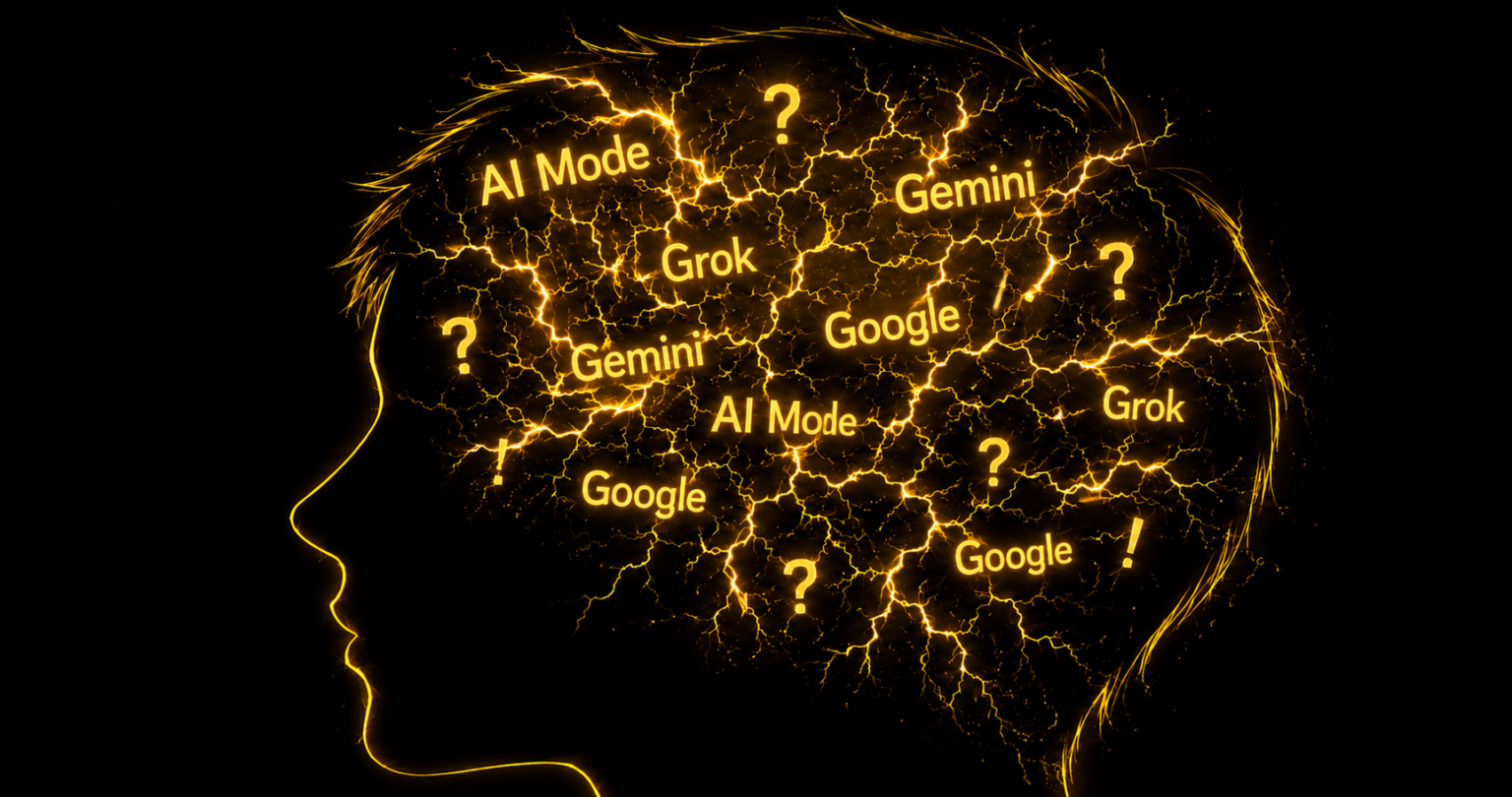
Googling, Gemini, AI Mode — the strategy is all over the place
Let me line up the names of the new Google features.
“Googling” — this became a verb. Everyone uses it.
“Gemini” — I hear it is a chat AI. Hard to remember.
“AI Mode” — I hear it is a feature inside search. I forget it right away.
“AI Overviews” — the summary that shows above the search results. This is also hard to remember.
All different things. I cannot remember any of them.
What are the people inside Google doing?
The brands are all over the place, and users are confused.
Is this not a failure of strategy?
As a man in my 60s, I ask you to make it easier to understand
For us, it is hard to keep up with new technology.
The names keep changing.
More features keep coming.
And they are pushed on us.
Simple is fine.
A name that is easy to remember, and a system I can use only when I need it.
That is what I want you to make.
Why did you throw away the simplicity of “Googling”?
I will think of names for you, without being asked — AskGle, TalkGle, LongGle
Finally, here is my uninvited proposal to Google.
Instead of “AI Mode,” how about names like these?
AskGle (Ask + gle)
You can tell at a glance that it means “ask Google.”
It can become a verb: “Did you AskGle it?” “Let us AskGle it.”
TalkGle (Talk + gle)
It feels like “talking with Google.”
I think young people might like it too.
LongGle (Long + gle)
It tells you “you can ask a long question.”
I see it as the next step after “Googling.”
Finally
Google, are you listening?
I am in my 60s.
I am not good with new technology, but I use Google every day.
That is exactly why I want to ask you this.
Do not push it on us.
Make the names easy to understand.
Leave us room to judge for ourselves.
And if possible, please think about something like “AskGle.”
This is just the selfish wish of a man in his 60s.
After 40 years in manufacturing, I see this as a failure
I worked on a manufacturing floor for 40 years.
Half of the causes of product defects can be traced back to the planning stage.
Google is probably a group of geniuses.
But the point of view of the user is missing.
The brand names are all over the place, and nobody can remember them.
In the world of production and manufacturing control, this is a clear failure.
I mean this seriously.
Google, can you hear me?


コメント